The Chiṭu-Eichengreen-Mehl Global Currencies Database (CEMGCD) brings together in one place multiple datasets on the history of the international monetary system collected over several years from a variety of sources on the currency composition of global foreign reserves, debt and oil markets.
We provide free open access to the data behind How Global Currencies Work (Princeton University Press), available also in Chinese, Hungarian and Spanish.
We also make available additional historical datasets, compiled with other co-authors, on financial sanctions, global foreign reserves, invoicing of international trade and exchange rates.
Some of these datasets will be updated on a regular basis. Others will be added over time.
Under the Terms of Use and Licence Terms below, the data is made freely available, expressly forbidding commercial data providers from integrating, in addition to any existing data they may already provide, all or parts of the dataset into their services, or to sell the data.

Currency composition of foreign exchange reserves (19 countries): 1890-1913
Eichengreen, Barry, Arnaud Mehl and Livia Chiţu (2019), “Mars or Mercury? The geopolitics of international currency choice”, Economic Policy, 98, pp. 315-363.

Currency composition of global foreign exchange reserves: 1899-2025
Barry Eichengreen, Arnaud Mehl and Livia Chiţu (2017), “How global currencies work: past, present and future”, Princeton University Press, Princeton: New Jersey.

Currency composition of global foreign reserves (incl. gold): 1947-2013
Eichengreen, Barry, Livia Chiţu and Arnaud Mehl (2016), “Stability or upheaval? The currency composition of international reserves in the long run”, IMF Economic Review, 64(2), pp. 354-380.

Currency denomination of global and European countries’ oil imports around World War II
Eichengreen, Barry, Livia Chiţu and Arnaud Mehl (2016), “Network effects, homogeneous goods and international currency choice”, Canadian Journal of Economics, 49(1), pp. 173-206.

Currency composition of global foreign public debt: 1914-1945
Chiţu, Livia, Barry Eichengreen and Arnaud Mehl (2014),“When did the US dollar overtake sterling as the leading international currency? Evidence from the bonds markets”, Journal of Development Economics, 111, pp. 225-245.

US holdings of foreign securities broken down by type and instrument: 1943
Chiţu, Livia, Barry Eichengreen and Arnaud Mehl (2014), “History, gravity and international finance”, Journal of International Money and Finance, 46(C), pp. 104-129.

Central bank asset seizures and freezes: 1918-2022
Krahnke, T., M. Ferrari Minesso, A. Mehl and I. Vansteenkiste (2025), “Seizing central bank assets?”, Journal of International Economics, 104207, December 2025.

Other economic sanctions (trade restrictions, asset freezes): 1914-1945
Eichengreen, B., M. Ferrari Minesso, A. Mehl, I. Vansteenkiste and R. Vicquéry (2024), “Sanctions and the exchange rate in time”, Economic Policy, 39(118), pp. 323–354.

Currency composition of foreign exchange reserves (80 countries): 1999-2020
Arslanalp, S., B. Eichengreen and C. Simpson-Bell (2022), “The stealth erosion of dollar dominance and the rise of nontraditional reserve currencies”, Journal of International Economics, 138, 103656.

Gold as international reserves (198 countries): 1980-2021
Arslanalp, S., B. Eichengreen and C. Simpson-Bell (2023), “Gold as international reserves: A barbarous relic no more?”, Journal of International Economics, 145, 103822.

Patterns of invoicing in global trade: 1999-2019
Boz, E., C. Casas, G. Georgiadis, G. Gopinath, H. Le Mezo, A. Mehl and T. Nguyen (2022), “Patterns in invoicing currency in global trade: new evidence”, Journal of International Economics, 136, 103604.

Official statements by Chinese authorities on exchange rate and reserve policy: 1997-2011
Fratzscher, M. and A. Mehl (2014), “China’s dominance hypothesis and the emergence of a tri‐polar global currency system”, Economic Journal, 124(581), pp. 1343-1370.

Real effective exchange rates (21 countries): 1880-2010
Fratzscher, M., A. Mehl and I. Vansteenkiste (2011), “130 years of fiscal vulnerabilities and currency crashes in advanced economies”, IMF Economic Review, 59(4), pp. 683-716.

Currency composition of foreign exchange reserves (17 countries): 1919-1939
Eichengreen, B. and M. Flandreau (2009), “The rise and fall of the dollar (or when did the dollar replace sterling as the leading reserve currency?)”, European Review of Economic History, 13, pp. 377–411.

Cross-border connections of fast payment systems (2000-2024)
NEW: Ferrari Minesso, M., A. Mehl, O. Triay Bagur and I. Vansteenkiste (2025), “Geopolitics and global interlinking of fast payment systems”, CEPR Discussion Paper, No. 20105.
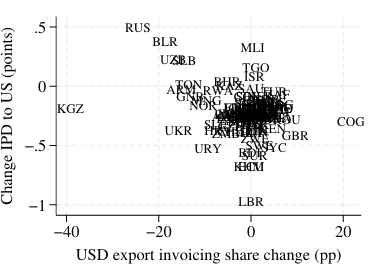
Patterns of invoicing currency in global trade, updates to 2023 and RMB data
NEW: E. Boz, A. Brüggen, C. Casas, G. Georgiadis, G. Gopinath and A. Mehl (2025), “Patterns of invoicing currency in global trade in a fragmenting world economy”, IMF Working Paper, No. 178.